
Which Holly Springs Records Are Open?
North Carolina law starts with broad access to material made or received in public business, yet it does not make every government file open. The decisive questions are who created the record and whether a statute shields it. Holly Springs departments keep council, planning, permit, police, contract, and administrative material. Wake County offices in Raleigh keep most deeds, tax rolls, court files, and county vital records. State agencies hold statewide court data, certificates, custody information, business filings, and voter data.
| Record group | Official keeper | Web access | Public access route |
|---|---|---|---|
| Deeds, liens, and plats | Wake Register of Deeds | Self-Service and Books! | Free index and many images; certified copies from the Register |
| Civil, criminal, and estate cases | Wake Clerk of Superior Court | eCourts case data | Portal, public terminal, clerk counter, or copy request |
| Property and tax | Wake Tax Administration | Current real-estate roll; bills from 1994 | Free web search, email, or counter |
| Birth, death, marriage, divorce | Wake Register, Wake clerk, or N.C. Vital Records | Series-dependent | Eligibility and identification rules depend on the copy |
| Town records | Holly Springs departments | Transparency and meeting portals | Posted file or focused online request |
| Custody and registry data | Wake Sheriff, N.C. DAC, or SBI | Official search tools | Public status data with statutory limits |
| Voter registration | NCSBE and Wake elections | State lookup and data files | Public fields only; protected details withheld |
The public and confidential parts can sit in the same file. A court docket may be public while a sealed filing is not. A deed image may be shown after a protected identifier is masked. Certified birth and death certificates have qualified-applicant rules, while some noncertified information may be available. Adoption and juvenile files, confidential personnel material, utility customer identifiers, and most criminal investigative details are not ordinary open records.
The Wake County Board of Elections records area illustrates that split between public administration and protected voter details.
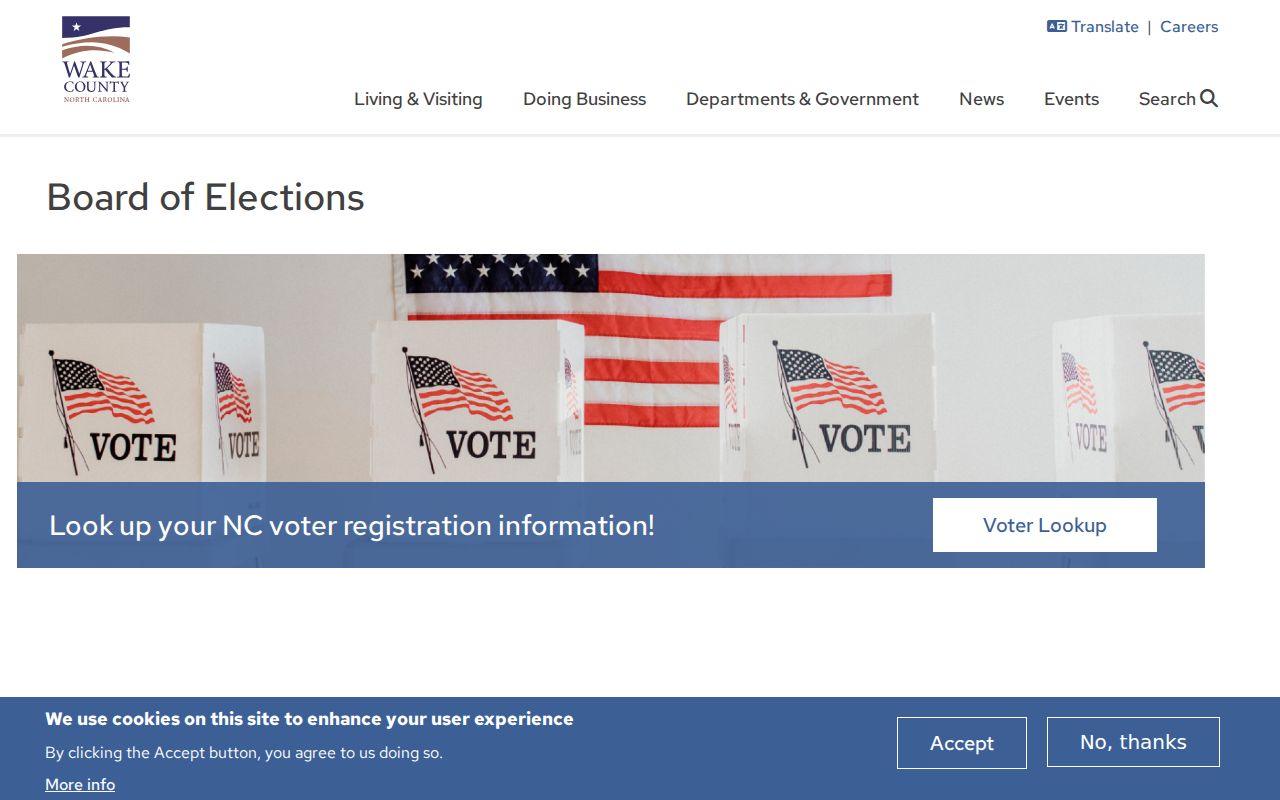
The county office is a custodian for election-administration records, but state law controls which registration fields may be disclosed.
Holly Springs Prompt Access Rule
North Carolina Public Records Law defines records by their link to public business, not by paper or digital format. G.S. 132-6 allows any person to inspect nonexempt records at reasonable times and obtain copies. A requester need not live in North Carolina or explain a purpose. The key timing phrase is “as promptly as possible.” Chapter 132 sets no fixed number of response days.
That rule does not require an office to create a new report, answer research questions, or reorganize data. Ask for an existing email, permit file, agenda packet, incident field, contract, or date-bounded set of messages. Narrow terms help a Holly Springs custodian locate material and identify exemptions. Electronic inspection can avoid copy charges when the file already exists in a useful form.
Note: A request that names the department, record type, people, and date range is easier to process than a broad demand for all related material.
Wake Deed Records Search Fields
The Wake Register of Deeds provides a free Self-Service index and the legacy Books! system. The index is a finding aid, not the legal instrument. Wake compares it to a library card catalog and advises checking every plausible spelling. A party can appear as a grantor, the person or entity conveying an interest, or a grantee, the recipient. Results may point to an image, but a certified copy still comes from the Register.
| Portal control | Input type | When needed | How it narrows the record |
|---|---|---|---|
| Search Type | Tabs or menu | One mode | Name/document, book-page, or document-number mode |
| Party Name | Text | Depends on mode | Surname and given-name variants; grantor or grantee |
| Record Date | Date range | Optional | Limits the recording period |
| Document Type | Dropdown | Optional | Deed, deed of trust, satisfaction, lien, plat, and other classes |
| Book and Page | Text pair | Book-page mode | Exact recorded volume and page; map books use BM plus four-digit year |
| Document Number | Text | Number mode | Exact instrument identifier |
A typical result identifies indexed parties and roles, document type, recording time, book and page or instrument number, page count, references, and an image link when digitized. The image may add signatures, consideration, a notary, legal description, and return address. Search terms should account for initials, former names, and spelling variants before concluding that nothing was recorded.
The Wake Books! recorded-book search remains the route to many historic books and maps.
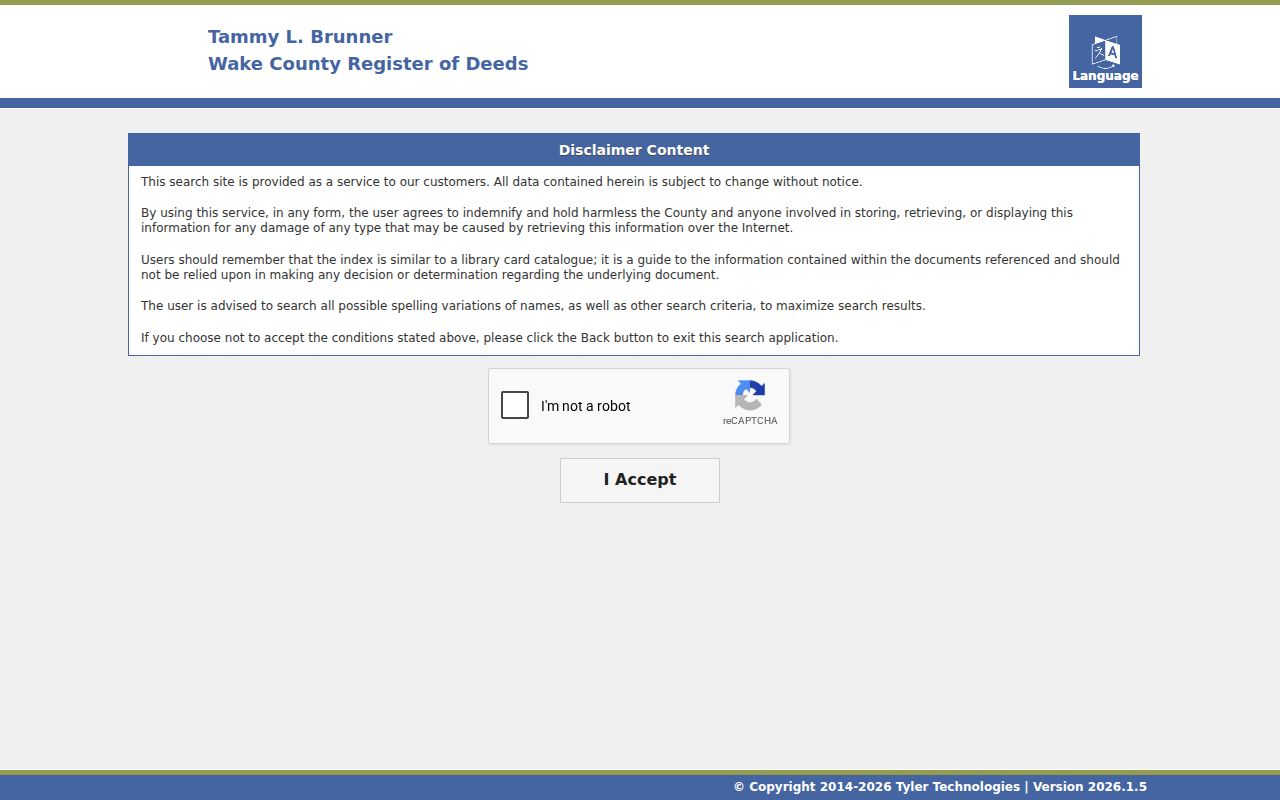
The book-and-page controls are useful when a parcel card or later deed already supplies the recording reference.
Holly Springs Land Records Cutover
Wake County changed land-record systems in April 2025. The verified legacy chronology runs from July 1785 through April 17, 2025. A new Records Management and Land Records system launched April 21, 2025. Those dates describe a portal transition, not a proven four-day gap in the legal record. Older and newer Holly Springs searches may therefore require different Wake interfaces.
This is also why “everything is in one online search” is a poor assumption. Series have different dates and imaging histories. An older deed, plat, or reference can still require Books!, a counter inquiry, mail, or help from the Register. The unusually long deed chronology also contrasts with online Wake tax bills, which reach 1994 rather than the eighteenth century.
- Index
- A catalog of names and recording references used to locate an instrument.
- Image
- A scan of the recorded instrument, which may contain details not entered in the index.
- Certified copy
- A copy formally authenticated by the custodian, not merely a downloaded portal image.
- Custodian
- The office legally responsible for holding and responding for a record.
- Exemption
- A law that closes a record or permits protected information to be withheld.
Holly Springs Records Office Routes
Holly Springs is not the Wake County seat. Raleigh is. That geography explains why a local records search often begins at Town Hall but moves to a county office for deeds, court files, or tax data. Use the town for municipal business and the named county custodian for the lasting legal file.
Holly Springs Town Hall
128 S. Main Street
Holly Springs, NC 27540
919-577-3111
Wake Register of Deeds
Wake County Justice Center
300 S. Salisbury Street, Raleigh
Deeds, plats, assumed names, marriage licenses, and Wake vital records
Wake Clerk of Superior Court
Wake County Courthouse
316 Fayetteville Street Mall, Raleigh
919-792-4000
Wake Tax Administration
301 S. McDowell St., Suite 3800, Raleigh
919-856-5400
Monday-Friday, 8:30 a.m.-5:15 p.m.
Town police material has its own route. Basic incident facts named in G.S. 132-1.4 may be released, but full investigative reports are generally outside ordinary Chapter 132 access. Holly Springs Police also handles accident information and requests. Body-camera recordings follow a separate statute, G.S. 132-1.4A.
Holly Springs Property Record Layers
The Wake Real Estate Search, tax-bill system, deed index, and iMAPS are related but distinct. The assessment roll ties an owner and mailing address to a site address, REID, PIN, value, legal description, and deed reference. A mailing address shows where tax notices go. It does not prove that the owner lives at the parcel. Tax bills add billing and payment history, while the deed supplies the transfer instrument.
iMAPS adds parcel shape, jurisdiction, aerial imagery, municipal boundaries, zoning, and other configured layers. It can help confirm whether a postal Holly Springs address sits inside town limits. The authoritative parcel record remains the better source for ownership. If an online label and a legal record conflict, check the PIN or REID and then the deed book and page.
The Wake and Raleigh iMAPS parcel viewer shows the geographic side of Holly Springs public records.
The map layers help resolve place and jurisdiction, while the tax roll and recorded deed establish the official ownership trail.
Note: Ownership and occupancy are different facts, so do not treat an owner name or mailing address as proof of present residence.
Holly Springs Court Record Custody
Holly Springs has no municipal court. Local cases run through Wake County District or Superior Court. The statewide eCourts Portal offers case information by party, case number, attorney, and other modes, but the Wake Clerk of Superior Court holds the actual file. A public docket can show a case number, caption, type, status, filed date, court, parties and roles, hearings, dispositions, and financial entries when public.
Portal access does not guarantee every document. Sealed matters, protected filings, victims, and confidential categories are excluded. Older paper files may need retrieval. Public courthouse terminals and the clerk counter are the fallback when online details are incomplete. A docket is the chronological list of case activity; a disposition is the recorded outcome of a charge, claim, or proceeding.
The separate N.C. Judgment Search can complement Portal results, while Smart Search gives the fuller summary. Portal training says person names use “Last, First,” results cap at 200, and broad searches should be narrowed by location, case type, status, or filing date. Full court copies and certifications still come from the Wake clerk.
Holly Springs Vital Record Access
North Carolina does not apply one simple age cutoff to all modern vital records. The important split is between certified and noncertified access. Under G.S. 130A-93, certified birth and death copies go to qualified applicants such as the subject, spouse, sibling, direct ancestor or descendant, specified step-relations, an authorized agent, or a person documenting a legal need tied to personal or property rights. Identity and relationship proof are required.
For an event in Wake County, the Register of Deeds is often the local route. N.C. Vital Records covers statewide birth records from 1913, death from 1930, marriage from 1962, and divorce from 1958. The state search fee is $24 per three-year period and includes the first copy if found; an additional same certificate is $15. Service and expedited charges can add to that amount. Earlier material may require the Register, Wake clerk, or State Archives.
Marriage licenses are recorded by the Register. Divorce case files belong to the clerk, while the state issues divorce certificates. A divorce certificate is not the judgment or docket. Adoption files are sealed under G.S. 48-9-102 and must be approached through authorized statutory channels.
Holly Springs Custody Record Lookups
Official custody tools cover different populations. Wake Sheriff’s Police-to-Citizen functions address county custody and local law-enforcement material. The N.C. Department of Adult Correction Offender Public Information search covers state prison, probation, and parole history back to 1972, not the county jail. The SBI registry is limited to people required by law to register. It is not a list of everyone accused or convicted of an offense.
State correction results may include names and aliases, offender number, physical details, conviction and sentencing data, custody location, transfers, release, and supervision status. Treatment, education, mental-health, and substance-abuse information stays confidential. Registry results can show a name, status, county, photo, descriptors, address, and offense data when the statute permits.
Use the scope statement on each official search. If a Wake inmate form is unavailable, do not replace it with an unofficial jail directory. Contact the custodian or use an agency records request for releasable material. Basic police facts and complete investigative files follow different disclosure rules.
Confidential Holly Springs Record Boundaries
Public access has firm limits. Adoption, juvenile, sealed, and expunged records are closed or restricted. Public utility customer identifying information is confidential under G.S. 132-1.14. Social Security numbers and specified personal identifiers are protected. The Driver’s Privacy Protection Act governs DMV personal data. Protected voter details include Social Security number, date of birth, email, driver-license number, voter-ID images, and the registering agency.
A common myth is that North Carolina’s Address Confidentiality Program erases old public records. It does not. The program gives an eligible survivor a substitute address for new records and forwards first-class mail. It cannot retroactively remove an already recorded Holly Springs deed or parcel entry. G.S. 132-1.10(f) does allow a written request to mask specified identifiers from a publicly accessible Register or clerk image, but that does not necessarily rewrite the underlying instrument.
Session Law 2025-79 adds a narrow limit on government disclosure of nonprofit member, supporter, volunteer, or donor affiliations. It is not a broad data-broker deletion law. Record-specific statutes still determine what a Holly Springs office may release.
Request Holly Springs Public Records
Begin with the office that holds the record. A town request belongs with Holly Springs. A deed goes to the Register. A court case file goes to the Wake clerk, not the statewide administrative office. Chapter 132 requests work best when they describe an existing file instead of asking an agency to investigate or answer a question.
- Identify the custodian. Use the record type, agency that created it, and whether it is municipal, county, judicial, or state.
- Check posted material. Search the relevant index or portal, then note a document number, parcel key, case number, date, or department.
- Describe the existing record. Give names, a focused date range, subject, department, and preferred electronic format when suitable.
- Ask about charges. Request an estimate before copy work or extraordinary staff and technology use begins.
- Review any redaction or denial. Ask for the statute supporting each withheld part, then narrow the request or use the available review route.
The Judicial Branch public-record request form collects requester contact fields and a description of the existing records sought.
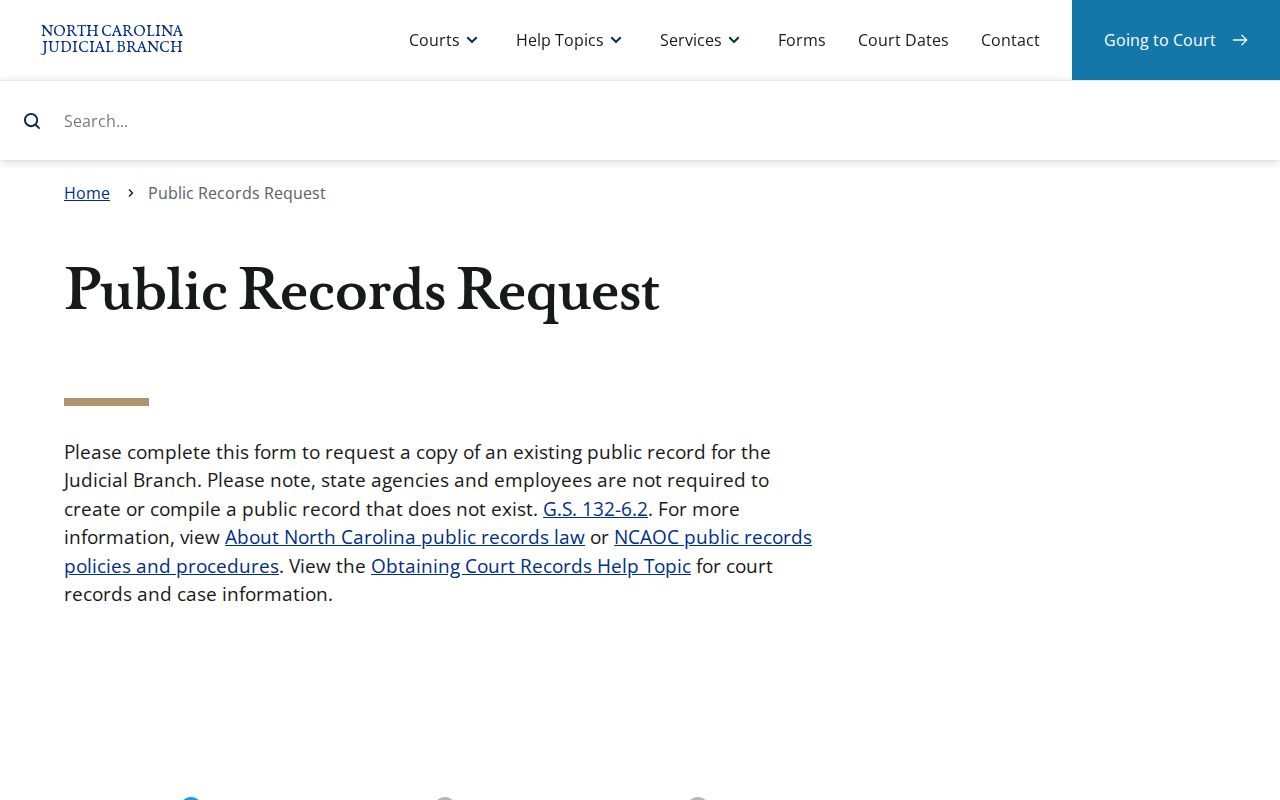
The form warns that NCAOC is not the custodian of county case files, case information, or certificates and will not perform a person’s case-history search. Those copies belong with the Wake clerk.
Holly Springs Records Costs and Review
Inspection is free under the general Chapter 132 rule. G.S. 132-6.2 permits actual copy cost and excludes ordinary agency labor. A special service charge may apply when a request demands extensive technology or clerical and supervisory help, based on actual incurred cost. The N.C. Judicial Branch policy illustrates the distinction with no inspection charge, copies at $0.25 per page, and possible extraordinary-request charges. Other custodians use their own lawful schedules.
If an office denies access, ask it to identify the exemption for each withheld or redacted part. A narrower date range or record category may resolve a dispute without losing the needed material. G.S. 132-9 provides superior-court enforcement, and specified matters may go through mediation. The goal is access to nonexempt records, not disclosure of protected information.
Lawful personal use. Use Holly Springs public records for legitimate civic, family, property, or personal research. North Carolina law prohibits stalking and forms of repeated threatening electronic contact, so never use record details to monitor, harass, intimidate, or harm anyone.
Official copies also provide a correction path that a compiled listing may lack. Verify names, dates, and status with the custodian before relying on them. A portal index can change, and an online result is not always the complete legal record.